Anonymous Q&A for All Hands Meetings: The Complete Setup Guide
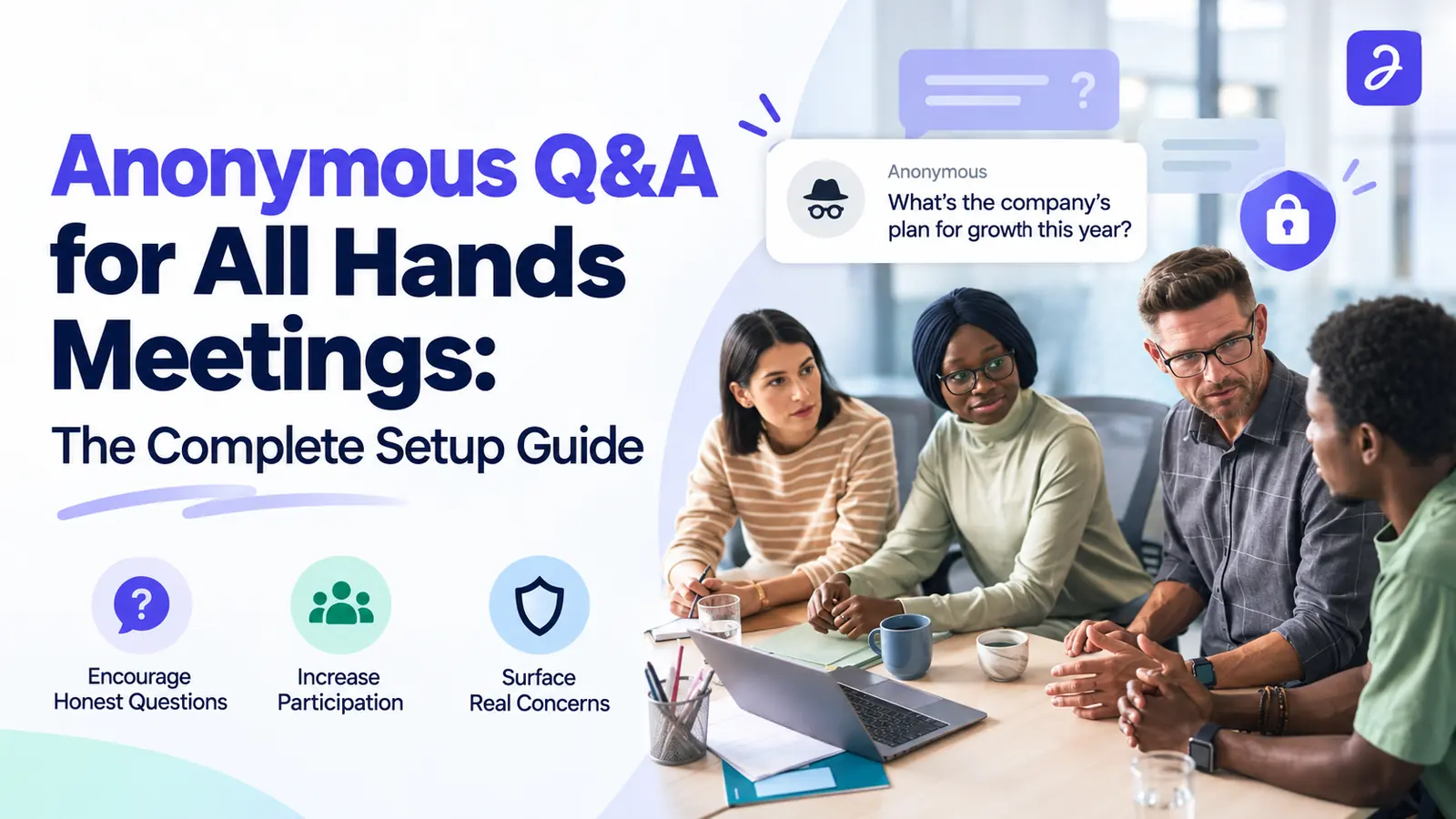
Picture your last all-hands meeting.
You just spent 45 minutes presenting the Q3 strategic roadmap. You covered the budget shifts, the new product features, and the slight restructuring of the marketing team.
You take a sip of water, look out at the sea of faces (or Zoom squares), and ask the dreaded question:
"Does anyone have any questions?"
Crickets.
Absolute, deafening silence.
A few managers nod approvingly. Eventually, one person asks a polite, softball question about the holiday schedule. You wrap up the meeting thinking everyone is perfectly aligned.
But behind the scenes, Slack channels are blowing up. Your team is confused about the restructuring, worried about the budget cuts, and completely skeptical of the new product timeline.
If you want to know what your team actually thinks, you have to change how you ask them.
Running an anonymous Q&A for all-hands meetings bridges the massive gap between what leadership thinks is happening and what the front line knows is happening.
This guide covers why anonymous Q&A works, how to run it without it turning into chaos, and which tools protect anonymity instead of just claiming to.
Key takeaways:
Silence in live Q&A doesn't mean employees have nothing to say
Anonymous Q&A tools work best when they allow real-time voting, so the most pressing questions rise to the top instead of getting buried
True anonymity requires no IP tracking or fingerprinting
Leadership needs a plan for handling tough questions before the meeting starts, not during it
Anonymous Q&A works best as part of a bigger psychological safety strategy, not a one-off gimmick
The Problem With the "Open Floor" Q&A
The traditional town hall Q&A ignores a fundamental reality of the workplace: power dynamics make honest upward feedback incredibly risky.
When your paycheck, your next promotion, and your daily comfort depend on leadership's approval, standing up in front of the entire company to question a strategic pivot feels like career sabotage.
The data backs this up. 67% of employees avoid giving feedback to their managers due to concerns about negative career consequences.
In fact, only 23% of employees feel comfortable sharing honest feedback with their managers.
The further employees are from decision-makers, the more filtered their input becomes. When the information reaches leadership, it is sanitized beyond recognition, creating a dangerous "leadership bubble" where executives genuinely believe everything is fine because negative information never reaches them in its raw form.
This is the same dynamic that shows up in why employees don't speak up at work more broadly.
Meanwhile, your frontline employees see problems daily but lack direct, safe channels to communicate upward.
HR teams realize the live mic doesn't work, so they send out a basic Google Form or Microsoft Teams link a week before the meeting, asking for questions. But there’s a problem with the submit-your-questions approach.

Why Standard "Submit Your Questions" Forms Fail
Employees have been burned before.
They have been promised anonymity only to face retaliation later when IT or HR looks at the backend data.
The key to unlocking honest feedback is true anonymity, not just promised anonymity. Employees know their writing style might give them away or that system logs could reveal their identity.
If you build an internal feedback form using Microsoft Teams, it almost always collects some identifying information behind the scenes. If your employees suspect you are tracking them, they will simply tell you what you want to hear or ask useless, safe questions.
Real anonymity must be engineered into the system. True anonymous channels require no IP tracking and no browser fingerprinting, meaning users cannot be identified by their device characteristics.
Platforms like JellyForm address these privacy concerns by design, ensuring no IP addresses are tracked and no cookies or identification methods are used that could compromise anonymity.
The Power of the Two-Way Anonymous Q&A
One of the biggest frustrations executives have with anonymous questions is that they lack context.
Someone submits a question that says: "Why are our internal processes so broken?"
As a leader, you cannot answer that in a town hall. Which process? Which department? Because it was submitted anonymously via a basic form, it is a communication dead end.
The most advanced approach to an anonymous Q&A for all-hands meetings allows back-and-forth dialogue while preserving anonymity. Two-way anonymous conversation systems allow employees to engage in ongoing dialogue, combining the safety of anonymous feedback with the depth of real conversation.
If a vague question comes in before the town hall, you can use a platform like JellyForm to reply directly to the submitter: "Can you tell us more about which specific process is slowing you down?".
The employee can provide additional context or updates, all while maintaining complete anonymity. This evolution beyond traditional anonymous suggestion boxes creates a much more dynamic feedback channel.
How Anonymous Q&A Actually Works
Anonymous Q&A for all-hands meetings works by giving employees a private link or form where they submit questions without any name, email, or identifying data attached. Other employees can then upvote the questions they most want answered, and leadership addresses the top-voted ones live or in a follow-up.
A basic anonymous form is fine for collecting questions. But without voting, you end up with 80 random questions and no way to prioritize.
The Core Components
1. A submission channel: a link, QR code, or embedded form employees can access from their phone or laptop during the meeting
2. Real anonymity: no IP logging, no cookies, no fingerprinting tying a question back to a person
3. Live voting: so employees signal which questions matter most before the meeting ends
4. A moderation step: someone reviewing questions in real time to filter spam or repeats
5. A visible answer process: questions get addressed live, or logged for written follow-up if time runs out
Tools like JellyForm's anonymous suggestion box handle this by combining a submission form with public voting boards, so employees see which questions are gaining traction in real time.
The voting and comments feature lets the crowd naturally surface the top three or four questions leadership should prioritize, instead of leaving it to whoever's moderating to guess.
Choosing the Right Anonymous Q&A Tool
Many "anonymous" Q&A apps still collect IP addresses, device fingerprints, or account logins behind the scenes — which means the anonymity is more of a UI choice than a technical guarantee.
Before picking a tool, ask these questions:
- Does it log IP addresses or use browser fingerprinting?
- Does it require employees to log in with a company email or SSO?
- Can admins see submission timestamps that could be cross-referenced with meeting attendance?
- Is there a real-time voting mechanism, or just a static question list?
- Can questions be moderated before they go live, without exposing who submitted them?
A lot of "free anonymous Q&A" tools are built for classroom polls or webinar chats, not for sensitive workplace conversations where employees are asking about layoffs, pay, or leadership decisions.
JellyForm was built specifically around that risk. There's no IP tracking, no cookies, and no fingerprinting — anonymity is engineered into the system, not just promised in the marketing copy.
Questions can also continue as two-way anonymous conversations after the meeting, so leadership can follow up on a question without ever knowing who asked it.
Running the Meeting: A Step-By-Step Process
Running an all-hands meeting with anonymous Q&A well takes more than just dropping a link in the chat. Here's a process that works for both in-person and remote teams.
Before the Meeting
Open the submission channel 24-48 hours early. This lets employees submit thoughtful questions instead of rushed ones typed mid-meeting.
Share it through multiple channels. Post the link in Slack or Teams, add a QR code to the meeting invite, and mention it verbally at the start.
Assign a moderator. Someone needs to watch the incoming questions, group duplicates, and flag anything that needs a careful answer.
Brief leadership on likely topics. If there's a round of layoffs, a controversial policy change, or a product delay, prepare leaders to answer directly instead of dodging.
During the Meeting
Keep the link visible throughout, not just at the start. People think of questions as the meeting goes on.
Show the voting board on screen if possible, so employees see real-time proof that their input matters.
Answer the top-voted questions first. Don't cherry-pick the easy ones and skip the hard ones — that's the fastest way to kill trust in the process.
Say "I don't know, but I'll find out" when that's the truth. A vague non-answer is worse than an honest "I don't know yet."
After the Meeting
Leftover questions don't get to disappear just because time ran out. Publish written answers within a few days, even for tough ones.
If leadership needs to check with legal or finance before answering something sensitive, say so publicly — silence reads as avoidance.
This is where closing the feedback loop matters most. An all-hands Q&A that never gets a follow-up trains employees to stop bothering next time.
Handling Tough Questions
Tough questions should get answered as directly as possible, even when the honest answer is uncomfortable. Hostile or bad-faith questions can be filtered out during moderation, but leadership should be careful not to dismiss a question just because it's uncomfortable to hear.
There's a real difference between "this question makes leadership look bad" and "this question is actually inappropriate." A question like "why did we lay off 50 people right after a leadership offsite in Cabo?" is uncomfortable but it's fair game, and dodging it will get noticed. A question that names and attacks a specific coworker, on the other hand, needs moderation before it goes live.
Set clear guidelines up front: no personal attacks, no naming individual coworkers
Let the moderator hold back questions that cross the line, but don't let them filter out anything just because it's tough
If a question repeats across multiple submissions, that's a signal — not spam
When leadership can't answer something fully (legal reasons, ongoing negotiations), say why instead of ignoring it
Organizations that treat anonymous Q&A as a PR filter instead of a real listening channel tend to see engagement drop fast. Employees notice when only the easy questions get picked, and they stop submitting anything real.

Getting Leadership Buy-In
Leadership buy-in for anonymous Q&A comes down to reframing it as risk reduction, not risk creation.
Some executives worry anonymous questions will turn into a free-for-all of complaints. In practice, anonymity surfaces real problems early, before they turn into resignations, complaints to HR, or public posts on Glassdoor.
Frame it for leadership this way: every question submitted anonymously is a question that was already circulating informally, just without leadership's knowledge.
The choice isn't between "employees have concerns" and "employees don't have concerns". It's between leadership hearing about them directly, or hearing about them secondhand, after morale has already taken a hit.
A short pilot at one all-hands meeting is enough to prove the point. Track the number of submissions, the quality of questions, and how employees react to leadership actually answering them directly.
Most teams see engagement jump the moment people realize their anonymous question got a real, unfiltered answer.
Getting Started
Anonymous Q&A turns all-hands meetings from a one-way announcement into an actual conversation, but only if the anonymity is real and the follow-through is consistent.
Skip tools that treat "anonymous" as a marketing label instead of a technical guarantee, and build a habit of answering hard questions directly instead of dodging them.
If you're setting this up for the first time, start small: pick one upcoming all-hands meeting, set up a dedicated anonymous board with voting enabled, and commit publicly to answering the top questions live.
JellyForm's anonymous feedback form can have this running in under 15 minutes, with no IP tracking or login requirements standing between your employees and the questions they actually want answered.